Deciding to purchase a home in the United States is one of the biggest steps anyone can take, whether you’re a first-time buyer, a newly arrived resident, or aiming for a new investment property. In my years helping people find the right path to homeownership, I’ve seen how government-backed programs like FHA loans truly open doors, particularly for those who feel the traditional path is just out of reach. The programs and the professionals at Heart Mortgage are dedicated to turning that challenge into a possibility, but there’s clarity needed around what it really takes to get approved. That’s why I decided to lay out the FHA loan requirements as plainly as possible—so you know what you need before starting your journey.
Why FHA loans matter
Sometimes, I meet buyers who almost give up at the word “qualification.” Maybe their savings aren’t as high as they wish, or credit stumbles have made them nervous. But FHA loans were designed with these very realities in mind. They exist to make homeownership accessible for more people.
FHA loans are backed by the Federal Housing Administration, allowing lenders to offer easier approval standards, lower down payments, and more flexible credit guidelines. If you’re worried that a bank will turn you away, this may be the path forward.

Who typically uses FHA loans?
Over the years, I’ve noticed some clear patterns. FHA home loans appeal to three main groups:
- People buying their first home, often with limited cash for a down payment
- Buyers with lower or recovering credit scores
- Anyone with high debt or limited monthly savings who still wants to stop renting
If you recognize yourself in these descriptions, you’re not alone. This segment of the market has always been central to FHA’s mission, and programs like Heart Mortgage focus on walking applicants through every step, addressing the nerves that naturally come with the process.
Breaking down FHA loan eligibility
Getting a home loan can feel like you’re solving a puzzle without the picture on the box. I want to give you that picture now by showing you the most direct path: what really counts when lenders review your application for an FHA mortgage.
Credit score expectations and flexibility
The minimum required FICO score for FHA loan approval is officially 500, but with a very high down payment requirement at that level. Not everyone qualifies just by passing that threshold; most lenders set their minimum closer to 580 for practical purposes.
- 500-579: Qualified with a 10% down payment
- 580 and above: Qualified with as little as 3.5% down
I’ve guided people who fall on both sides of that number. Even so, most experts, myself included, recommend working to reach at least 580 if you can, since the smaller down payment frees up your cash for emergencies, moving costs, or repairs after move-in. While some exceptions exist, trying to buy with a score below 580 typically means more money upfront and, at times, tougher approval odds.
Down payment percentages and savings
One of the most common questions I receive is about the cash needed for a down payment. FHA is known for making this manageable, even for those who fear they don’t have enough saved.
- With a score of 580 or higher, the minimum down payment is only 3.5% of the property’s purchase price.
- With a score between 500-579, the minimum down payment rises to 10%.
Let’s say you want to buy a $300,000 home. At 3.5%, you’ll only need $10,500 down. That’s a big difference compared to the 20% often expected for conventional loans. Plus, FHA lets you use “gift” money from family members or eligible charitable organizations for your down payment, as long as it’s properly documented.
Debt-to-income ratio: How much can you safely borrow?
Lenders need to be sure you won’t struggle, so they look carefully at your debts as a share of your income. This is called the debt-to-income, or DTI, ratio. It includes all your monthly debt payments compared to your gross (pre-tax) monthly income.
For most FHA loan applications, your total DTI should not exceed 43%. That means monthly debt payments, including the projected mortgage, should not be more than 43% of your pre-tax salary. However, I’ve sometimes seen approvals allowed up to 50% with strong compensating factors, like excellent savings, high credit scores, or extra income.
If you’re unsure how you measure up, online calculators or a quick word with the team at Heart Mortgage can help you estimate your number. Honest assessment here matters, because feeling “house poor” can be avoided if you know your limits up front.
Stable employment and qualifying income
FHA lenders look for steady work history and consistent, documented income. Normally, they’ll want to see at least two years in your current job or field. Gaps are allowed, as long as you can explain them and show you’re back on solid ground.
Your wages, salaries, bonuses, commissions, and even some types of government assistance, can count as acceptable income. All of them must be documented with W-2s, pay stubs, or tax returns. Side income or self-employment is considered too, but more documentation may be requested. The main goal is to prove you’re likely to keep making enough to pay your bills.
Residency and lawful presence
You don’t have to be a U.S. citizen to qualify, but you must be in the country lawfully and intend to make the house your home. FHA loans are for primary residences only—no vacation homes or pure investment properties. Permanent residents, non-permanent residents, and citizens are all eligible, provided they can show legal status and valid Social Security numbers.
Property requirements: More than just bricks and paint
One area clients often overlook is the property itself. The home you want to buy must meet specific standards for health, safety, and value. The FHA uses property appraisals with particular requirements to protect both you and the lender.
What appraisers look for
I’ve sat with buyers as they waited on an appraisal report, fingers crossed. FHA appraisers review both the market value and the home’s basic condition.
- The home must be your primary residence (where you’ll live most of the time)
- The property must have adequate heating, water, electricity, and a sound roof
- No serious safety hazards or structural damage can be present
- There must be reasonable access—no homes only reached by unpaved tracks in flood zones, for instance
- Major appliances must be installed and working
- There are special checks for lead-based paint on homes built before 1978
The home must meet local building codes and FHA minimum standards, or you may need repairs before closing. Your real estate agent can usually help spot any red flags before you make an offer, and lenders like Heart Mortgage often offer pre-approval or contractor suggestions if issues are found.

FHA mortgage insurance: What it is and how it works
Many potential buyers are surprised to discover that FHA loans have special insurance requirements, known as Mortgage Insurance Premiums, or MIP. Unlike private mortgage insurance (PMI) on some non-FHA mortgages, MIP is required for nearly all FHA loans and helps keep the program running by protecting lenders.
How FHA mortgage insurance premiums are structured
- Upfront MIP: You pay 1.75% of the loan amount at closing, which is often rolled into your loan price so you don’t need to pay it out of pocket.
- Annual MIP: This premium is divided into monthly payments and added to your mortgage bill, usually between 0.15% and 0.75%, based on your loan amount and down payment.
For many, the monthly cost adds between $40 to $140 per $100,000 borrowed. This does increase the total cost of your loan, but it allows the FHA to keep offering low down payment options to more buyers. If this insurance seems confusing, you might find practical explanations in Heart Mortgage’s FHA loan guide for first-time and low-credit homebuyers.
Most FHA loans require mortgage insurance for the entire life of the loan if you put down less than 10%. With more than 10% down, MIP usually goes away after 11 years.
While mortgage insurance does make things a bit pricier, the payoff is access. It means you can own a home now instead of waiting years to save up a large down payment or rebuild your credit.
Understanding loan limits for FHA-backed mortgages
Each year, the FHA sets limits on how much you can borrow, and these caps depend on the local home market and property type (single-family, duplex, etc.). Living in an expensive city? The limit is higher. Smaller towns or rural areas have lower loan limits.
- For 2024, most single-family homes across the U.S. have a cap between $498,257 and $1,149,825, depending on county.
- Higher limits exist for 2-4 unit properties, making them attractive for buyers considering multi-family options.
To see your local limits, check the official HUD website, or allow my colleagues at Heart Mortgage to assist with a custom check. If you want more in-depth information on loan limits and eligibility, a resource like the complete mortgage loans guide for U.S. homebuyers might help clear things up.
Comparing FHA loans to conventional mortgages
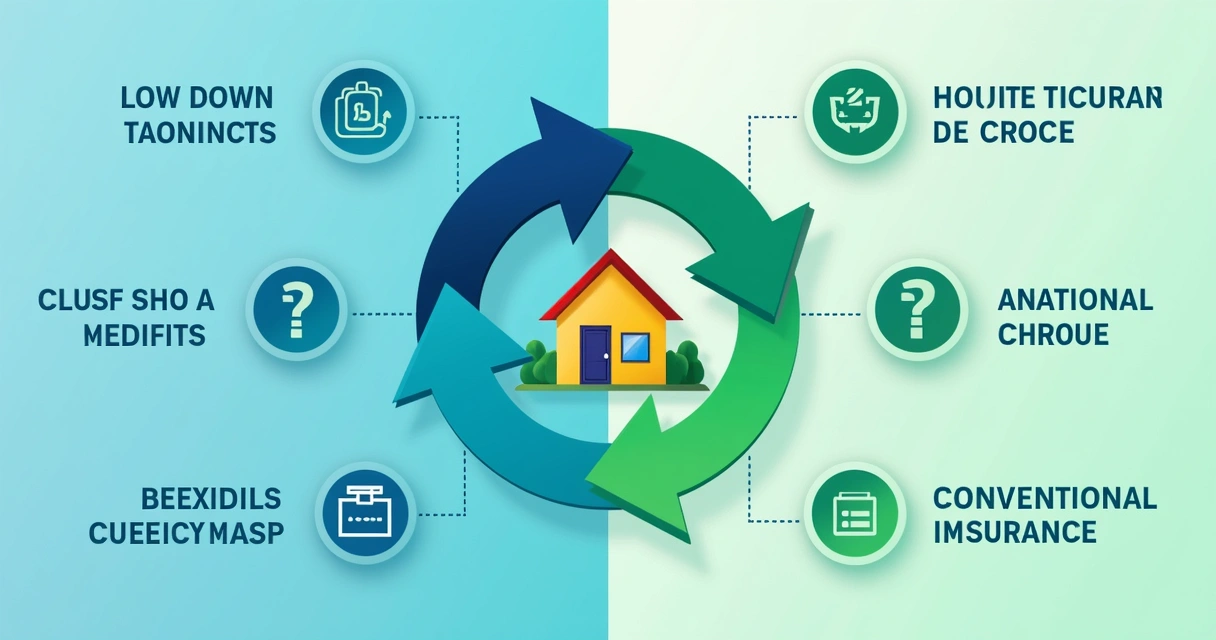
The biggest question I get is, “Should I go FHA or try for a regular, conventional loan instead?” The answer always comes down to your unique situation. There are clear differences worth noting.
- Credit requirements: FHA loans are well-suited for buyers with lower scores, while conventional loans are less forgiving.
- Down payments: FHA can go as low as 3.5%, compared to 5-20% for many non-government loans.
- Loan limits: FHA has defined caps, while conventional loans may allow higher borrowing amounts depending on creditworthiness.
- Mortgage insurance: FHA always requires it, while you may be able to cancel PMI on conventional loans once you reach 20% equity.
- Flexibility: FHA loans have looser standards, especially for applicants with major credit events like bankruptcy or foreclosure in the recent past.
However, if you have strong credit, steady income, and plenty of cash saved, a conventional loan from a program like those at Heart Mortgage could save you on long-term mortgage insurance costs. Again, the choice comes down to running your own numbers—and being honest about your current financial stage.
When is an FHA loan a better choice?
From what I’ve seen, you might choose FHA if:
- You have a credit score under 680
- Your cash reserve for the down payment is modest
- You want more flexible approval after a credit issue
- You plan to live in the home, instead of buying it as a second property or investment
- Your debt load makes traditional approval tough
Conversely, those who qualify easily for conventional loan standards probably won’t benefit as much from the FHA’s extra insurance costs. For a deeper look at when FHA and other loan types fit, see the advice in resources for first-time homebuyers or browse comparisons available on the Heart Mortgage homebuyer blog.
How to prepare for your FHA loan application
The application process doesn’t need to be daunting if you’re organized from the beginning. Getting approved has a lot to do with your paperwork and financial readiness. Over the years, I’ve seen how small steps before applying make a big difference in approval outcomes.
Organize your documents
I always advise applicants to gather all required documentation well before they start the formal process. This includes:
- Government-issued ID (like a driver’s license or passport)
- Social Security card
- Two years of tax returns and W-2s
- Two recent pay stubs or proof of self-employment income
- Bank statements for the last two to three months
- Documentation for any additional income or assets (child support, investments, etc.)
- Proof of any recent large deposits (including gift funds)—with a signed gift letter if needed
Having these on hand not only shows the lender you’re responsible and proactive, but it also speeds up closing. Delays often happen because the lender is still chasing after missing papers.
Review your credit and address mistakes
Order your credit reports and review them for errors early in the process. A surprising number of people find old debts or mistakes that pull their scores down. Correcting these can lift your score above the key thresholds and improve your loan terms. If you’re unsure how to clean up your report, there’s help available—talk with your lender before starting, and you’ll know what steps to take.
Lower your debt or boost your savings if possible
If you still have time before applying, every payment toward debts or addition to your savings helps. Paying down balances, closing unused credit accounts carefully, and keeping spending in check can help your DTI and your risk profile. Not everyone can do this, but even small changes have helped my clients get better results.
Get pre-qualified for reassurance and negotiation power
Many home buyers wait until they find a property to contact a lender. In my experience, you’ll have more peace of mind—and more leverage in negotiations—if you get pre-qualified or pre-approved before you shop. Not only does it give you a price range, but sellers also take you more seriously, which can matter in a competitive market.
Stories from the field: FHA loans in real life
I’ll never forget helping a couple who had just moved to the US. They’d saved steadily but couldn’t reach a 20% down payment and felt overwhelmed by their limited credit history. After reviewing their financials, we set up an FHA loan. Their down payment was manageable, insurance was rolled into their monthly payment, and they managed to buy a safe, comfortable home near their new jobs. That moment—keys in hand—gave them genuine relief and pride.
Or the solo parent who rebuilt their credit after a tough chapter. The FHA program didn’t just approve their application; it restored their faith that homeownership was within reach. Behind every policy, there’s a story like this, and they’re the reason teams like Heart Mortgage remain so dedicated to guiding clients step by step.
Big goals start with small steps.
Conclusion: Taking your first step toward homeownership
If you’re asking yourself whether you might qualify for an FHA loan, you’re not alone—and you’re not out of options. The guidelines are made to include more buyers, not exclude them. The practical requirements, from credit score to property standards, exist simply to ensure a secure home and loan for everyone involved.
Whether you’re just starting to plan or you’re ready to make your move, I encourage you to reach out to the experts at Heart Mortgage. Their goal is always to offer not just clear information, but real partnership, proven through years of supporting buyers just like you. Check out their guides, use their resources, and take that next step with confidence. Your new home, and a more secure future, could be closer than you think.
Frequently asked questions
What are the main FHA loan requirements?
The basic FHA loan guidelines include a minimum FICO score of 500 (with higher scores lowering the down payment), a consistent work/income history (usually two years), reasonable debt-to-income ratio (typically no higher than 43%), a lawful ability to live in the U.S., and buying a home that will be your primary residence and meets safety standards. You’ll also need to pay required mortgage insurance premiums, and your desired property must fall within local FHA loan limits.
How much credit score is needed?
Most lenders look for a credit score of at least 580 to qualify for the lowest down payment of 3.5%. Technically, you can qualify with a score between 500 and 579, but you’ll need to put 10% down. Even so, reaching 580 tends to make approval and affordability much more manageable.
What documents are required for FHA loans?
You’ll usually need a government-issued ID, Social Security card, two years of income documentation (such as W-2s and tax returns), recent pay stubs, two to three months of bank statements, proof of other income or assets, and, if you’re using gift funds, a letter documenting those gifts. Self-employed buyers will need extra paperwork like business tax returns and profit and loss statements.
Is an FHA loan a good option?
If you have a lower credit score, limited savings, or recent credit issues, FHA loans can be a practical and effective solution for becoming a homeowner. They’re often the best path for first-time buyers or those who don’t fit the mold required by conventional financing. Always compare loan types with your lender or a trusted advisor to see which fits your needs best.
How much down payment is needed?
With a credit score of 580 or higher, you can put as little as 3.5% down on an FHA loan. If your score is between 500 and 579, you’ll need a 10% down payment. Using gift funds for part or all of your down payment is allowed, as long as it’s properly documented.